
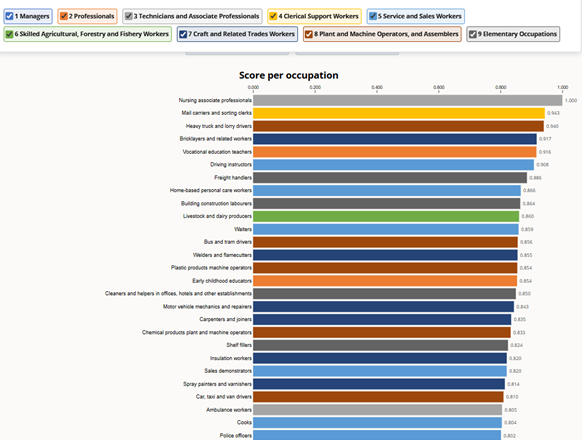
Employers across the EU in sectors such as construction, healthcare and transport are reporting difficulties in recruiting suitable staff. To help answer the question of whether there is a genuine labour shortage in specific occupations, Cedefop, in cooperation with Eurostat, has introduced a new indicator based on data from online job advertisements.
The indicator analyses millions of online job advertisements from the 27 EU Member States to identify occupations showing early signs of recruitment difficulties. Each occupation is assigned a score between 0 and 1 – the higher the value, the stronger the signal of a potential labour shortage.
What distinguishes the indicator from existing tools
The indicator takes into account:
- changes in demand for a particular occupation;
- changes in labour demand in relation to employment in the occupation;
- changes in the digital skills required by employers;
- indications of recruitment difficulties, reflected in how long online job vacancies remain posted;
- changes in employers’ recruitment strategies – for example, posting more vacancies in a non-national language in order to reach a wider pool of candidates.
The indicator also stands out in terms of its level of detail. Occupations are not grouped into broad categories, such as healthcare occupations, but cover more than 300 individual occupations. For example, healthcare professionals are distinguished from generalist medical practitioners and pharmacists.
As it uses data on online job vacancies that are close to real time, the indicator can also serve as an early-warning mechanism, helping policymakers identify emerging labour market pressures and respond more effectively.
Which occupational sectors show signs of shortages?
Initial results indicate potential shortages among occupations requiring medium-level skills, manual occupations and occupations requiring no formal qualifications, as well as in several occupations in healthcare, education, construction and vehicle operation.
Why is this important for European policies?
Reliable and detailed signals of labour shortages are an important building block for evidence-based policymaking. They can support the development of targeted measures in education and training, active labour market policies and migration management.
Part of a wider set of analytical tools
The new indicator complements Cedefop’s existing tools for analysing skills and labour market trends, including the Skills Forecast, the Labour and Skills Shortages Index, TalentGap and the European Skills Index. Together, these tools provide a more comprehensive picture of current and future labour market developments across the EU.