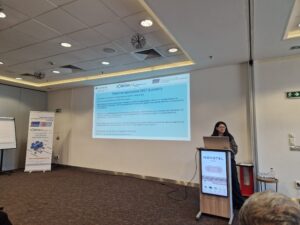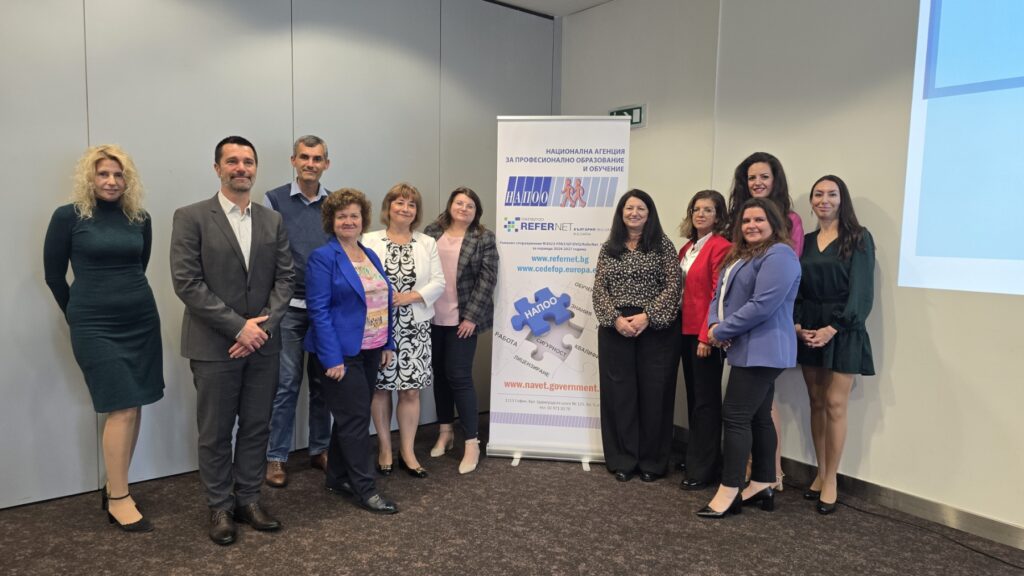
Current challenges facing vocational education and training (VET), European policies and innovative approaches to modernising the system were at the centre of the Annual National Conference “European Dimensions in Vocational Education and Training”, held on 15 October 2026.
The event was part of the activities of ReferNet, the European network for the exchange of expertise and information in the field of vocational education and training. The National Agency for Vocational Education and Training (NAVET) is the ReferNet representative for Bulgaria.
The forum was opened by Eng. Mariyana Pavlova, Chairperson of NAVET, and brought together leading experts and representatives of NAVET, the Ministry of Education and Science, the Ministry of Labour and Social Policy, the Regional Department of Education – Sofia, trade unions, employers’ and sectoral organisations, vocational education and training centres (VET centres) and vocational schools. The main objective of this year’s event was to identify the key challenges facing vocational education and training and present practical solutions for modernising the system in line with current trends.
European experience – a basis for better VET policies
The National ReferNet Coordinator, Ms Petya Evтимova, presented the network’s activities and its main outputs – reports, studies and analyses providing comparable information on vocational education and training systems across European countries. These materials support the European Commission in developing policies and defining directions for modernising VET in line with the needs of Member States.
Particular attention was also paid to the analytical publications of the European Centre for the Development of Vocational Training (Cedefop), which provide comparative research, in-depth analyses and recommendations supporting national VET policies.
Data, funding, flexible and digital solutions for system modernisation
The conference programme covered a range of practically relevant topics related to the development of vocational education and training in Bulgaria.
Ms Desislava Ilieva (NAVET) presented data on training delivered in 2025 by vocational training centres under the 2003 List of Professions for Vocational Education and Training (LPVET-2003), compared with the results for the first half of 2026 under the new 2024 List of Professions for Vocational Education and Training (LPVET-2024). The analysis highlighted important trends in the training activities of VET centres in the context of the transition to the new list of professions.
Modern digital tools were also in focus. Ms Lyuba Krasteva (NAVET) demonstrated the interactive List of Professions for Vocational Education and Training, developed under the project “Modernisation of Vocational Education and Training”. The tool facilitates navigation through the current LPVET-2024 and provides easier access to information on vocational education and training.
Ms Adelina Borisova (NAVET) presented the regulatory framework and opportunities for organising training in part of a profession and in individual units of learning outcomes. These forms provide additional opportunities for flexible development of knowledge and skills in response to individual needs and changing labour market requirements. Current data on training of this type delivered by VET centres in 2026 were also presented.
Ms Rositsa Stelianova (BICA) and Mr Ivaylo Naydenov (MLSP) presented opportunities, key findings and recommendations regarding the financing of adult learning in Bulgaria, with a focus on conditions for expanding access to lifelong learning.
Innovation in training – Cybersecurity
The participation of Mr Andrey Ivanov and Mr Dimitar Ivanov, former students of the “Alexander Stepanovich Popov” Vocational High School of High Technologies in Sofia, attracted particular interest. Winners of a prestigious award in an international competition, they presented interactive solutions they had developed for modern cybersecurity training.
Their contribution demonstrated how the initiative, technological skills and creativity of young people, supported by the right mentors, can be applied in practice in the learning process and contribute to the development of competences in such a rapidly changing field.
The Annual National Conference reaffirmed the importance of professional dialogue and the exchange of good practices among institutions, training providers, social partners and representatives of the educational community.